There has been some noise recently on Planet Gnome about ColorVision Spyder2 support in Linux ArgyllCMS. Ross Burton reported success in profiling his display with this screen calibration device.
So I had to try for myself 🙂
Stefan Dohla provided an easy way to compile ArgyllCMS under Ubuntu Gutsy:
1. add yourself to the src group
# sudo vim /etc/group
change the line src:x:40: to src:x:40:yourusername
2. install the jam build tool – use FTJam
# sudo apt-get install ftjam
3. install the X11 XVidMode development package
# sudo apt-get install libxxf86vm-dev
4. create a directory for Argyll in /usr/src , e.g.
# mkdir argyllcms
and enter it
# cd argyllcms
5. download latest Argyll version (use a beta version if available)
# wget http://www.argyllcms.com/argyllV0.70Beta7_src.zip
6. unzip the downloaded file – watch out: there’s no folder created and the content is extracted into your current directory!
# unzip argyllV0.70Beta7_src.zip
7. Run the build script
# sh makeall.ksh
If all compilation goes well, go into the spectro directory. You should find there a spyd2en utility that takes a file from the Spyder driver to use it in Linux (yes, that injects proprietary code in ArgyllCMS). The file is CVSpyder.dll, which you can also pass as a argument to spyd2en, in case.
Afterwards, you can just plug your Spyder and use dispcal to start your monitor calibration. Now the main task is to figure out the command line options available and what they do 🙂
As a first test, I simply put:
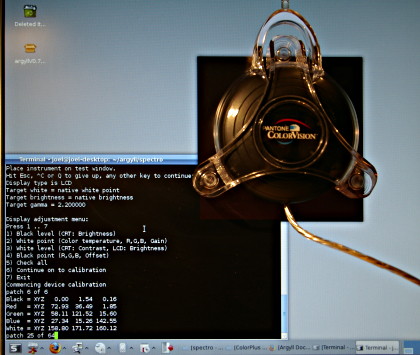
sudo ./dispcal -v -y l ./test
I had to run dispcal as root otherwise it wouldn’t allow me to access the usb colorimeter – I guess changing the permissions of /dev/bus/usb/… would have been a more elegant solution…
-v is for verbose
-y l tells dispcal to calibrate an LCD monitor (-y c for CRT)
./test.cal is the output profile.
I was then asked what I wanted to do:
1) Black Level (CRT: Brightness)

2) White point (Color temperature, R,G,B, Gain)

3) White level (CRT: Contrast, LCD: Brightness)

4) Black Point (R,G,B, Offset

5) Check All

6) Continue on to calibration

7) Exit
Since this was just a test run (and this was not my photo monitor anyway), I hit 6.
The calibration took forever and a day to complete (measuring a gazillion of patches, averaging plenty of deltaE, checking candelas/m2 and iterating again and again – well 64 patches time 3 iterations). Much longer than in Windows.
This process spit out a test.cal file which was loaded via:
./dispwin ./test.cal
As far as I can see (this was just a quick first test run) the result is as good as can be – I tried loading a profile made under Windows and the Linux one; my display was very similar. OK this is not a scientific test (!!) but it tells me nothing is way off.
By the way, my colorimeter is a (primitive) Spyder 1, so both the Spyder 1 and 2 are supported.
That is for the good – Graeme Gill, you utterly rock!!
The ugly is that ColorVision is just releasing a Spyder 3 to the market and has been quite aggressively dismissing any idea of support towards OSS – as you can read in this long thread on the OpenICC mailing list. Which made Hal V. Engel say with wisdom:
The correct response to ColorVision not wanting anything to do with open source is to return the favor and have nothing to do with them.
So if you have a Spyder 1 or 2, support for Linux is (almost) here. If you are shopping for a (relatively cheap) colorimeter, check Huey 🙂
And with that, the last photography thing that I needed to do under MS-Windows is gone…

 Linux Photography
Hey there, I love that this blog is still going strong!
I had some bad luck recently, I bought a new lens, 50mm f/1.8 and took just a few shots with it, and last Saturday the camera strap slipped loose and my Canon 400D + lens fell on the tiles from roughly 1.4 meters. Thank the Canon engineering gods for my camera surviving that without a scratch, but the lens was shattered… 😦
Oh well, I am looking for a color management solutions, but I have a dilemma. Right now I have a Iiyama HM204DT Vision Master Pro 514 (which is a super 22″ flatscreen CRT monitor, 2048×1536 resolution) . I am thinking however of just buying a macbook and dualboot leopard with ubuntu. To use this monitor as external monitor is more than the macbook can handle, and I don’t want to buy a macbook pro. Also for aesthetic purposes, I will probably buy an LCD monitor. But then I don’t want the 6 bits per channel crap TN panels, but a real color LCD monitor… expensivo…
Now my dilemma: should I buy a Spyder / Huey for this CRT monitor and then use it to calibrate with the eventual macbook’s own lcd panel, and later the LCD monitor? Or do I need a special colorimeter for LCD and one for CRT? They are so damn expensive for something you use perhaps once a year. (Besides, I never print myself, I have my shots printed by a studio)
Nice to read your blog again! Keep it up.
Fan from the first hour 🙂
Hi Yves,
Always a pleasure to read from you… except in that particular case. I have seen the pic on flickr and it’s not pretty 😦 Still by seeing the lens, you wouldn’t expect the camera to have survived.
When it comes to monitor calibration, the Spyder works both on a LCD or CRT (although the patches being sent are not the same ones). In ArgyllCMS, you have an option to get a CRT or LCD profile (in dispcal the -y switch) so you should be fine. Apparently the Pantone Huey does LCD and CRT but I don’t know how well it is supported under Linux.
Thanks for your support !!
Joel
I followed your instructions on my Ubuntu system, but got the following error message “/usr/bin/ld: cannot find -lXss” which was solved by installing the missing screensaver libraries: “sudo apt-get install libxss-dev”.
Thanks for the nice howto!
Hi Boran,
Thanks for your comment. I tend to have so much “dev” stuff on my Ubuntu that I don’t know which ones are used to build which packages…
Take care,
Joel
I followed the instructions and have some hints for newbies like me.
Make sure all the .ksh and .bat files in the argyllcms directory are executable.
Make sure you have one of the required compilers, GNU c++ works fine:
sudo apt-get install g++
If you are using a Huey or Huey Pro (I have the latter), make sure there is no light shining on the display because the Huey is just a colorimeter under argyllcms and doesn’t appear to be correcting for ambient lighting.
Be conservative on the time out of your screen saver when calibrating 🙂
Thanks for the great article.
Regards,
John
Hi John,
Good to know the Huey Pro (at least) works also on Linux. Good times for Linux photography. Thanks for your contribution.
Take care,
Joel
Hi,
i’m trying to follow your tutorial, but i don’t find the commands like dispcal, they don’t work. The only thing i can find is dispcal.c in the spectro dir. I tried to install g++ but i get an error…
Ok, i downloaded the wrong version 🙂
Hi Lysbertus,
Some nice macros on your blog. Congrats!
Take care,
Joel
Thanks a lot! jcornuz! Feel free to comment on my blog 😉
Great tutorial by the way, i’m borrowing a friends spyder this weekend so i’ll be using your tips for making a icc profile under Ubuntu.
cheers,
PJ
I Have access to a Spyder2 Pro and wondered if anyone has experience in getting it to work with Ubuntu 7.10
Hi Ron,
I had a Spyder1 running on Gutsy (7.10). Spyder2 should work the same way.
Take care,
Joel
I was wondering if anybody ha experience with Spyder2Pro specifically. I only
need monitor calibration
Hi Ron,
As far as I know, the Spyder2Pro comes with the Spyder2 colorimeter – the “Pro” bit is about the software package that goes with it, and that is Windows and OS X only. So you should have no problem using it for monitor calibration under Linux (not sure about projector, though). Hope this helps.
Take care,
Joel
Thank you for the help
What command could I issue before my friend comes around to my house, to test if I have installed Argyll correctly ?
Hi Ron,
Good one… I guess until you actually have the hardware in hands, there is no way to know for sure. Check if you got any build error and if dispcal exists.
You may want to try loading a profile via dispwin; if you download xcalib, it comes with a blueish.icc which makes your monitor all blue – that is a good testbed.
Take care,
Joël
First, thanks for producing these excellent articles. I finally feel I understand colour management – a subject I first encountered with MacOS 9, where it confused me utterly.
I wondered – has anybody tried running a calibration tool under WiNE? If it worked it would seem to be one way to do things like this without needing driver support. The thing that occurs to me is that you might end up with calibration that only works when WiNE apps are running.
If i still feel that there was no need to read this article, you would have to concede that i truly know what all needs to known about LCD, but if the answer is no, i must be glad of reading this article.
Hi Joel,
I was wondering, would it be possible to run the Spyder2 software in Windows to get the calibration file and then just have Linux load that profile? In theory (and I admit, I’m new to Linux, so I could easily be wrong here), you’re using the same monitor, with the same settings, on the same computer…with the same file. The only difference being the OS that starts it up. I found a couple of ICC profile managers/loaders in my repository, so that’s why I was asking…seems like it would be a heck of a lot easier to me, unless you don’t have a dual-boot…but even then, you could still probably do it through VMWare or Win4Lin on the XP VM, then copy the file over to the Linux side.
Hi Justin,
As far as I remember, using a Windows made profile under Linux is OK – see https://jcornuz.wordpress.com/2007/11/08/using-windows-made-monitor-profiles-in-linux/
Still, Spyder2 can create profiles for you in Linux via ArgyllCMS – see https://jcornuz.wordpress.com/2007/11/18/use-colorvision-spyder-to-produce-an-icc-monitor-profile-under-argyllcms-linux/
Take care,
Joel
Why compile? You can download the executables and this seems to work?http://www.argyllcms.com/Argyll_V1.0.3_linux_x86_bin.tgz
I have a Spyder 3 elite and Ubuntu 10.04 LTS – the Lucid Lynx.
Has any one used this combination with any success to calibtrate a monitor (Dell lcd) and an Epson 2400 with Gimp.
I am not very good in terminal but can get help from the local guys and dolls.
Regards
Eric
determined to lose windows in the dust !
contact correction
I have a spyder 3 and lucid lynx. I installed argyll using synaptic and it seems to be working fine. Have not completed the calibration yet but s/w is communicating with spyder and black level adj worked.
Hi Jerry
Thanks for this.
I think I need to start it in terminal but cannot get it started :-((
So how do I get going ?
Eric
OK so I have installed dipscalGUI, that seems to have done the trick :-))
Now I have to work out the configuration specifics.
Once installed and could not find the help file i went blindly on and used the numbering request system in the terminal that pops up after choosing one of the three choice at the bottom of the pop up when you open dipscal.
Now I just have spend some time learning what does and does not work for my set up.
Regards to all
Eric
Hi,
you write:
If all compilation goes well, go into the spectro directory. You should find there a spyd2en utility that takes a file from the Spyder driver to use it in Linux (yes, that injects proprietary code in ArgyllCMS). The file is CVSpyder.dll, which you can also pass as a argument to spyd2en, in case.
It simply doesn’t work for me. I try with argyll 1.0.3 Version from ubuntu repos.
I have the CD for a spyder 1, I have it installed on a windows partition, I copied it to my home directory, but from neither place it is possible to make spyd2en to read the file:
me@home:~$ spyd2en -v ./CVSpyder.dll
Size of input file ‘./CVSpyder.dll’ is 77824 bytes
spyd2en: Error – Failed to locate Spyder 2 firmware
What am I doing wrong here?
Thanks!
Same song for me…
Or even when I rename the “PhotoCAL Setup.exe” from the CD into “setup.exe” in my home directory…
What’s wrong with the Spyder 1 and Argyll ?
Thanks !
Found the solution, I guess…
Find spyd2PLD.bin wherever you can (try http://www.alphadxd.fr/download/file.php?id=6101, in french, subscription required, click in “inscription”, or else you should find it now on kademlia…).
Place it in the directory where argyll bins are (/usr/bin for me).
And then, it should work fine. :o))
Hi I use dispcalgui_0.5.8.1_amd64.deb in combination with Argyll CMS in Lucid
I have a Spyder 3
It works just fine so maybe I am lucky, the only thing not working is ambiant light which I don’t really need.
Hope this helps
Eric B
Hi,
I’ve successfully used my Ubuntu 10.10 (maverick), spyder3, argyll (1.1.1), dispcal and dispcalGUI (0.6.6.8) to calibrate my monitor.
Excellent software.
/Peter
OK so I have now spent more time on the calibration and i have ambiant light working as well now.
Oh and I use mtink for my Epson r2400 photo printer ink levels but need to figure out how to get all functions working in that.
All working pretty well now (better than when I used MS stuff :-))
Thank you! Worked great with Spyder2 Pro on RHEL 5. I had to track down some additional rpms, but then everything worked fine. Thanks.
Thanks , I have recently been searching for info approximately this topic for
ages and yours is the greatest I’ve came upon so far. But, what in regards to the bottom line? Are you positive concerning the supply?
I was curious if you ever thought of changing the layout of your
website? Its very well written; I love what youve got to
say. But maybe you could a little more in the way of content so people could connect with it better.
Youve got an awful lot of text for only having one or two images.
Maybe you could space it out better?
Any news on Spyder4 support for Linux?
dispcalGUI is able to recognize Spyder4, tested to work in Ubuntu 13.04.
http://dispcalgui.hoech.net/
It’s aesome to pay a quick visit this website and readinbg the
viuews of all colleagues oon thhe topic of this post, while I am aloso eager of
getting experience.
continuously i used to read smaller articles or reviews that as well clear their motive, and that is also happening with thiis post which I am reading now.
Hello There. I found our blog using msn. This iis an extremely well written article.
I’ll make sure to bookmark it and return to rdad more
of your useful information. Thanks for the post.
I will definitely comeback.
You ought to be a part of a contest for one of the greatest blogs on the net.
I am going to recommend this web site!
Hey! I just wanted to ask if you ever have any
problems with hackers? My last blog (wordpress) was hacked and I ended up losing several weeks of hard work due
to no back up. Do you have any methods to protect against hackers?
Hmm is anyone else experiencing problems with the pictures on this
blog loading? I’m trying to figure out if its a problem on my
end or if it’s the blog. Any suggestions would be greatly appreciated.
Thanks on your marvelous posting! I definitely enjoyed reading
it, you can be a great author.I will ensure that I bookmark your blog and will often come back down the road.
I want to encourage continue your great writing,
have a nice weekend!
If you desire to grow your knowledge simply keep visiting this web site and be updated with the most recent
information posted here.
You ought to be a part of a contest for one of the greatest sites online.
I’m going to highly recommend this site!
I loved as much as you will receive carried out right
here. The sketch is tasteful, your authored material stylish.
nonetheless, you command get bought an nervousness over that you wish be delivering
the following. unwell unquestionably come further formerly again as
exactly the same nearly very often inside case you shield this increase.
My spouse and I absolutely love your blog and find most of your post’s to be exactly I’m looking for.
Do you offer guest writers to write content for yourself?
I wouldn’t mind producing a post or elaborating on some of the subjects you write about here.
Again, awesome weblog!
No matter if some one searches for his vital thing, therefore he/she wants to be available that in detail, therefore that thing is maintained over here.
Article writing is also a fun, if you be familiar with after that you can write otherwise it is complicated
to write.
Hi, I do believe this is a great blog. I stumbledupon it 😉 I’m going to come back once again since I bookmarked it.
Money and freedom is the best way to change, may you bee rich and continue to help others.